
I’m going to apologize for the length of this essay ahead of time, but it’s wild that in 2026 a serious and smart group of sociologists continue to signal that classical texts written over a century ago provide some sort of consistent, orthodox, verifiably true epistemic, ontological, axiological, and methodological position. I sometimes feel like a broken record, or Don Quixote, or Sisyphus. But, like those metaphors, it is sometimes necessary to keep doing something until it changes or until you are accused of being crazy. So, why push the proverbial rock up again and again? Why care about Durkheim’s Suicide so much? Here are a few reasons.
- Studying suicide, like studying other pressing public health problems, has direct consequences. Disseminating good theory is not just a matter of philosophic argument, but could be a matter of life or death if we intend on intervening in some form or another. It affects families and friends. And, if we accept the meta-Durkheimian mission to explain human societies in ways that could allow us to intervene thoughtfully, suicide is as thoughtful a place to intervene as any.
- Suicide is as empirical as it is theoretical. Consequently, not only have its theoretical ideas been hermetically sealed in taken for granted conventional wisdom, but so too have its empirical findings (Merton 1967:150-152; Wray et al. 2011). This is dangerous, particularly because few sociologists bother to read how his hypotheses have faired over the last 100 years of empirical scrutiny (Halbwachs 1979; Breault 1994; Mueller et al. 2021). We just come to take for granted there are four types of suicide, Durkheim settled the sociology of suicide, his types explain suicide rates and suicide better than anything since, and egoistic and anomic suicide are really important (more on this shortly).
- It is often held up, conventionally, as Durkheim’s great accomplishment of proving that social facts sit apart from psychological facts. He devotes an entire chapter in the beginning of the text about how suicide notes are too subjective, motives are useless things to study, yada yada. You know the drill. Incidentally, and germane to my point, he also spends a chapter rejecting imitation (and, really, his great rival Gabriel Tarde), but like most classical theorists and most arguments in the beginning of these oft-sprawling texts, it is an open question how much he rejected the argument itself or the conceptual frame Tarde posited. (More on this shortly).
For these reasons, and more, it is one of the best texts for teaching students how to read, use, and appreciate classical theory. It also is an ideal cautionary tale revealing how and why we need to stop wrapping these texts and, more importantly, the conventional wisdom gleaned from our own masters, in velvet so that we can light some incense and worship them at the altar. One of the earliest moments in my career that shook my own clarity was reading Jeff Alexander’s (1982) text that walked through every one of Durkheim and Marx’s classic works. In his sharp analysis, he asks the reader why Durkheim included a third book in his dissertation, The Division of Labor in Society? Then walking through the myriad moments Durkheim contradicts his own thesis about the function of the division of labor in the main text, he begins to show that Durkheim came to add three caveats that resolved the problems he couldn’t resolve; he negated his thesis (could you imagine a grad student destroying their own thesis in their thesis?!?). Did he really? Well, we have no proof from the horse’s mouth. But, it is telling that within 2 years of publishing it, Durkheim turned his entire theoretical eye to emotion and religion, leaving behind the political economic debates he chose to initially wade into. Nary a word about divisions of labor, organic or mechanical solidarity pop up again; anomie shifts from a structural thing to something entirely different in Suicide; and by the end of his career, he unironically adopts Tarde’s preferences for social psychological analysis as the Elementary Forms of Religious Life become about symbols, meaning, interaction rituals, and knowledge production. But, I digress.
What We Generally Think Durkheim Said
I can’t analyze the whole conventional wisdom received (see, Pope 1975, Pescosolido 1994, Bearman 1991), and for those interested in the serious Durkheim scholars who are less concerned about the empirics that are inextricably tied and necessary to his argument, see (Lester 1994; Pickering and Wolford 2000), but here are the basics. Durkheim presents us with a macro-level (population-level) model of suicide. It is macro because he is interested in suicide rates and their variation in time and/or space. Rates, he argues, are clean and objective, eliding human randomness, subjective emotion and psychology, and other unnecessary things. He, in a sense, sacrifices answering the most imperative question (why do people choose to die by suicide [Barbagli 2015]) in favor of demonstrating the veracity of his assertion that social facts are real and affect human thought and behavior. Had he chosen to just argue suicide rates vary based on the structure of social relationships, I wouldn’t be able to make claims I have made elsewhere. He would have stuck to his methodological guns, so to speak. But, he couldn’t help arguing that there are different etiological forms or types of suicide.
What I mean to say is he offers a second proposition: social relationships vary in terms of their integration or regulation, allowing him, at least as the conventional sociological model presumes, to posit four types of suicide (Bearman 1991). Two of each represent ideal typical poles on a continuum: too much or too little integration (altruistic & egoistic suicide) and too much or too little regulation (fatalistic & anomic suicide). As he lays this out, he argues that weaknesses in relationships cause suicide. That is, living in a place with high divorce or unemployment rates (anomic structures) or Protestant-majority places make people more vulnerable to suicide. Now, he wants his cake and to eat it too. On the one hand, he initially notes we cannot predict that any individual person, say a Protestant in a particular congregation or an educated bachelor in a city and, when they do die by suicide, it makes no sense in asking about their own subjective perspective because, as he noted early, most people don’t really know why they do stuff (never mind this weak cultural dupe argument [Martin 2011]). But, on the other hand, Durkheim is in the business of laws and he builds a set of hypotheses that he believes (and sociology has taken) to be law-like (Merton 1967); even in the face of empirical scrutiny that denies the law-like nature of his assumptions (Habwachs 1979; Pescosolido 1990), theory text books continue to teach these 19th century hypotheses as laws. Notably, this causal argument has been blasted for committing an ecological fallacy in assuming distal macro-level things (integration/regulation) are causally related to individual-level things (people dying by suicide). This gives contemporary sociologists an out: the conventional believers argue studying suicide rates as aggregates of human behavior avoids having to explain suicide or suicidality, just suicide rates. We are not asking why people die or examining any individual case. Rather, we are just observing the flux of suicide rates and their association with things like unemployment rates.
But, close examination of the text itself raises lots of questions about this common interpretation of Durkheim. Before digging in, I can point easily to something outside of my interest in this essay: suicide contagion or suggestion. In a famous chapter, Durkheim rebukes his rival, Gabriel Tarde, and his imitation thesis. However, at times in that very chapter, Durkheim argues that moral epidemics, as he calls them, happen and are sociologically relevant, just not in ways Tarde suggests. He only returns to this insight in his chapter on Altruistic suicide where he recognizes the medieval monastic epidemics that occured with some frequency (Murray 1998). Returning to the common interpretation, so much of what I just laid out is not really true. For instance, does Durkheim have four types of suicide? If so, why does he devote massive space to altruistic, egoistic, and anomic and a single paragraph and footnote for fatalistic (1951:276)? Why does fatalism not factor into Book III of Suicide, where he lays out the general theory itself? Thus, when Parsons once asked “Who now reads Spencer?”, I think it a fair question to ask “Who actually reads Durkheim’s Suicide in its entirety and carefully?”
A cursory look at all the sociological theory readers and textbooks available on Durkheim for graduate and undergraduate education quickly reveals we read his pronouncements about psychology and justification for sociology; egoistic and anomic suicide; and, occasionally, a bit on altruistic (where he poorly and haphazardly lays out three types of altruism with anecdotal data). But, so little else is discussed or considered. Why do we do this? Well, rhetorically, this is what Durkheim actually wanted (more in a second). At a meta-level, this text was propaganda: he wanted to make the ultimate case that sociology was distinct from its sister disciplines. He was the progenitor of all that status anxiety that persists today: science envy; jealously of the success of economists and psychologists; an uncanny ability to challenge any efforts to use biology or psychology to help support our arguments on reductionist grounds while unironically employing untested and unfounded psychological arguments that neatly fit sociology (Wrong 1962, 1963). Thus Durkheim’s Suicide is far from a closed matter. If we are to take his larger project of making sociology a serious science, then shouldn’t we do better? Shouldn’t we try to actually see what Durkheim said? And, shouldn’t we use the same sociological imagination he used in building his theory rather than just test and re-test his 19th century hypotheses (Wray et al. 2011)? And, finally, shouldn’t we treat his own shift to emotions and religion and interaction as warrant to take more seriously their appearance, unsystematic as they may be, in Suicide? Or, should we just pretend as though the rhetorical force Durkheim uses to make salient what his own biases felt were most salient are actually the truth and fundamental basis of a Durkheimian theory of suicide? His closest confidants, Mauss (1979) and Halbwachs (1978) both would reject this latter claim, but what do they know? Maybe just showing you the contradictions and some of the promises of doing this can convince you?
Macro-Level Theory?
Usually, I would begin this sort of essay with a deep theoretical take, but let’s start with the argument an esteemed colleague leveled against my own analysis of a high-profile suicide. The argument revolved around aggregates and not individual cases, which is usually attributable to the multi-variate statistical analysis Durkheim is famous for. Can we reasonably take a statement made at the outset of a 300 page book at face value? Particularly from a classical theorist?
As a first piece of evidence, let’s consider his treatment of altruistic suicide. In this chapter, Durkheim uses virtually zero statistics or macro-level analyses (besides some really basic descriptive data on military deaths). Using (absurd and quite wrong anecdotal cases), Durkheim argues for three forms of altruism (p. 227): obligatory, optional, and mystical. Hindu Sati, or the religious practice of Hindu women throwing themselves on their husband’s funeral pyre or a funeral pyre, is obligatory, Durkheim reasons, despite evidence that suggests it is closer to homicide in most cases (Abrutyn 2017). From there, Durkheim calls out an interesting, but undeveloped historical case: medieval monastic epidemics “caused by excess religious fervor” fit the bill (Murray 1998). Then in an equally bizarre twist, he argues the military rate of death vis-à-vis civilians could be interpreted as altruistic. Not because they threw themselves on a hand grenade or took a bullet for their troop, but because the act of signing up was voluntarily submitting to potential death and the intention of dying whether at one’s own hand or the enemy’s was suicide! This great example of Durkheim’s methodological acumen actually hews closer to the methods he used in The Elementary Forms of Religious Life than the bookend chapters surrounding it. Indeed, as I’ll note later, Durkheim even chooses a label that violates his cherished rules set out at the beginning of the book: altruistic suicides are motivated by self-sacrifice! Of course, again, Hindu women rarely self-sacrifice in the ritual act of sati, nor do I imagine slaves self-sacrificing when their master dies. But, whose counting? A critic could push back here, noting that Durkheim did aruge these types were relics of traditional, pre-state societies and thus statistics were not only impossible to assess but the structure of society was significantly different from today. Sure, but in throwing out one of four categories that comprise the internal architecture of a theory, we start to put the theory and method on shaky ground. Moreover, it begs incredulity to assume tight-knit, mechanical communities no longer exist—my own research suggests this is nonsense (Abrutyn et al. 2020) as does a massive literature on suicide clusters in high schools, prisons, psychiatric wards, some Indigenous communities, islands, and military bases (Niedzwiedz et al. 2014). Inconvenient facts, to be sure.
When we turn to another of the four types, fatalism, we are met with an even worse challenge to the macro assertion. First off, Durkheim mentions it once in the 300+ pages. In a single paragraph in a footnote on p. 276. Again, he reveals his cards and tells us this type isn’t really important to sociologists, but maybe historians. He follows with uncharacteristic sloppiness, suggesting three examples: slaves, childless middle-aged women, and newly married bachelors; none of which are backed by any statistical or anecdotal data, and all of which share some undefined and vague characteristic. It is a true wonder that this hastily and poorly thought-out type has reached equal levels with the three massive empirical chapters devoted to egoistic, anomic, and altruistic suicides. It is even more mind-boggling that few question what macro-structural features we can identify as universal across those three cases! If we toss this type out, along with altruism, half of his theory goes bye bye. Its generalizability is suddenly reduced to two types and is both time- and place-bound. The fact that people stick to the conventional model is perhaps the reason no one has bothered to empirically test, with aggregated data, fatalistic or altruistic suicide (Christies and Davies 2000:36-52).
Finally, network models (Pescosolido 1990; Pescosolido et al. 2020) have increasingly fixed the empirical holes in Durkheim’s own population-level methods. Over time, it has become clear that characteristics of places (Abrutyn 2023) and networks and not qualities of states or other macro-level units of analysis that make Durkheim’s theory work. And, it is decidedly not incompatible to study suicide rates at those levels and using his theory; or, studying the interaction between people and their choices and these levels of social reality (Abrutyn and Mueller 2016, 2018). Why integration and regulation do not operate or have proximate measurements at the social psychological level is mystifying (Halbwachs 1978; Travis 1990). The latter though speaks to a thorny secondary issue raised by many strict orthodox Durkheimians: motives and motivation.
Motives Need not Apply
Durkheim does, in fact, reject psychological motives, but in always ignored chapter (pp. 277-293), the one that follows his three great chapters, Durkheim shifts from etiology to morphology and surprisingly elevates a set of emotional characteristics that certainly reek of motivation, but also underscores a patterned sociological structure at the level of social psychology.

It sure seems that Durkheim had sociologically relevant motives in mind. We could choose to write this chapter off. It is the end of Book II; like altruism and fatalism it is anecdotal in some cases, but I do not see the justification for picking and choosing what parts of Suicide we use to formulate Durkheimian theory and which we choose to just toss aside. So, how about reading his words. Here is how he opens the chapter:
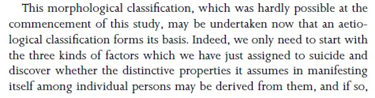
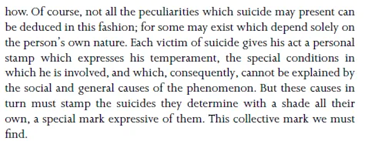
It would appear as though Durkheim clearly understood all of his work in those previous chapters as a set up for identifying patterns in emotional and social psychological characteristics of individual suicides and predicting what might happen. He is cautious, to be sure. He notes that we cannot predict or explain every suicide; randomness and other factors remain viable. But, there is a patterning to environments, events (like disruptions), and structured and culturally-determined feelings, thoughts, and actions that makes individual cases less subjective than psychological methods and theories presume they are. I cannot emphasize just how powerful and theoretically useful this chapter is, as it allows us to really make headway in dealing with some of the usual critiques leveled against the positions the common interpretation stakes out in his name. It is a short leap to suggest that suicide remains a social act and therefore replete with intersubjective meanings that make it an option or constrain the likelihood of attempting suicide while elevating other culturally-relevant and accepted behaviors that externalize how we feel and our identification with others who feel like us (e.g., opioid abuse, alcoholism, domestic violence). Moreover, a compatible Durkheimian socioemotional theory is lurking in plain site (Abrutyn and Mueller 2014). Need more evidence of this, how about this banger (Durkheim 1951:285):
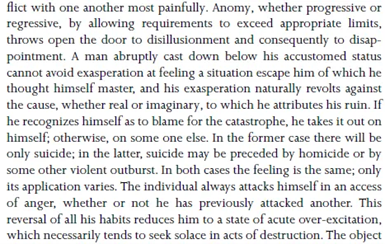
Still not convinced? We could pull from comments he makes throughout the body of other chapters unrelated to the Individual Forms chapter. For instance, talking about altruistic suicide—the type with a name that suggests a motivation!—he remarks that “the individual kills himself purely for the joy of sacrifice” (p. 223). How does it differ from its logical opposite, egoism:” While the egoist is unhappy because he sees nothing real in the world but the individual, the intemperate altruist’s sadness, on the contrary, springs from the individual’s seeming wholly unreal to him….and the melancholy of one is quite different from that of the other. That of the former consists of a feeling of incurable weariness and sad depression…That of the latter on the contrary springs from hope…It even implies enthusiasm and the spur of a faith” (225-6). I cannot think of more motive-based sociological comments, but notably, they tow the line between straight up psychological reductionism and, within the context of his social structural model, sociologically patterned motives that do not require that we take interlocutors at their word, but that we can assume that emotions are structured in predictable ways (Kemper 1978). Put differently, if integration and regulation are Durkheim’s ultimate causes, the morphological types found in that table above are the proximate causes that defy subjectivism and psychologism.
As further proof, in a previous set of remarks, Durkheim noted the following about egoistic suicide:
When society is strongly integrated, it holds individuals under its control…and thus forbids them to dispose willfully of themselves…But how could society impose its supremacy upon them when they refuse to accept this subordination as legitimate…They, on their part, have no reason to endure life’s sufferings patiently. For they cling to life more resolutely when belonging to a group they love…The bond that unites them with the common cause attaches them to life and the lofty goal they envisage prevents their feeling personal troubles so deeply (209-10)… the less he feels himself a real participant in the religious faith to which he belongs, and from which he is freeing himself; the more the family and community become foreign to the individual, so much more does he become a mystery to himself, unable to escape the exasperating and agonizing question: to what purpose?” (212).
Ok, so what now?
I am going to leave the biggest looming problem for another day (what do we do about a purportedly general theory with four types of which its progenitor relegated two to the dustbin of history? And, sociologists being who they are, went along with this ploy without even thinking about the ramifications for his theory?). Instead, I want to make a couple of final points. First, to declare anything concrete from an opening salvo by a classical theorist or really anyone is a dubious strategy. I could begin a paper on emotions by arguing astrology is pseudoscience and makes no difference to an analysis on emotions at the outset, and along the way, pepper the paper with astrology. We cannot forget the standards and rules of rhetoric that a nascent social science had: virtually zero. Durkheim was a lawyer in his approach, often spending chapters making his foe’s case only to demolish it later. To not evaluate those claims over the course of the text is foolhardy.
Second, Suicide is not readable in a vacuum, and it is clear that Durkheim was quite serious by that point (read the second preface to The Rules of the Sociological Method, for instance) about emotions (collective, sure, but emotions nonetheless) linking people to the supposed external, coercive social facts around them. Unsurprisingly, this overarching concern found its way into a serious though NEVER read or taken serious chapter and analysis of the morphology (or structure) of suicide (not suicide rates). The language I have used in my career to translate Durkheim’s 19th century, Cartesian-subscribing European white dude’s language about emotions is fair game (Abrutyn and Mueller 2014; Abrutyn 2019). Particularly in so far as many other sociologists have made sense of it in similar fashion (Berger 1969; Mestrović 1985).
Taken together, Durkheim’s model is explanatory at the level of the case. He knew this to be the case. If we just draw a correlation between recessions or unemployment and suicide rates, we are doing nothing theoretically interesting. Why? Why do people die? Why would Protestants in some congregations be at a risk of dying vis-à-vis Protestants in another? In the text, between the tables, are a bunch of words explaining the logic of integration and regulation, which regardless of one’s assertion that Durkheim said this at the beginning of the essay, fall into the meso-level worlds we inhabit. That is perhaps why network analyses have been quite successful at eliding the ecological fallacy and showing with better precision how and why relational structure makes people more vulnerable or protected against suicide (Pescosolido 1994).
Now to return to the dog that’s not barking: Jason Arday’s suicide, though a tragedy, was entirely predictable—that is, a reasonable prediction that like most scientific predictions (e.g., predicting an earthquake or when a leaf might fall off a tree in Autumn) depends on variables of myriad nature, not least of which whether he had acquired and was capable of applying a suicide script. It is fair to criticize me for not waiting for the official medical or coroner report declaring it was a suicide. I might be proven wrong, though in 15 years of studying suicide, Durkheim’s own morphological types have provided us with pretty accurate predictions for suspicious deaths. If I have to eat crow, so be it. Nevertheless, it does not negate that his death – so long as it turns out to be suicide – is eminently explainable within a Durkheimian framework. Though Durkheim was not a Weberian theorist of status, he was intimately sensitive to sudden drops in status that brought ignominy to the person and, worse, their family; hence his recurring concern with bankruptcy:

Let me be clear, again: it is not the sadness or shame that kills the person. Arday did not kill himself because he evaluated his situation and decided the shame was too unbearable to handle, though the best psychological work on this indicates wanting to escape the pain of a damaged social self is paramount to overcoming the fear of death (Baumeister 1990). Rather, it was the environment (a 24-hour social media/news media + right wing racist cycle), event (high profile collapse of a massive, and complex con game), the violation of a set of cherished expectations plus the sudden and irreversible loss of status, and as Durkheim said in his short paragraph on fatalism, a choked future due to the visibility of Arday’s fall (what on Earth was he going to do for a living after this? And what career could he find purpose in?), the shame (yes, shame is a generic, ubiquitous social emotional response to status loss, and Durkheim knew this!) which likely fed back as his privacy became smaller and smaller. Was suicide a guarantee, nope. In many Rust Belt communities, the culturally prescribed way of handling this sort of social pain is opioid use. Indeed, variation in handling status destruction does not negate my argument or even challenge Durkheim’s thesis, as he states quite clearly in the beginning and later in Book III that his theory should explain any pathological (or presumably prosocial) behavior; suicide just fit his political and ideological project ideally.
Ultimately, I have no qualms entering into these debates. Or ill-will for those that criticize my methods or even motives for entering into this discussion. Mostly, I think moments like this demonstrate the power of sociological theory and prove Durkheim’s model still holds water when adjusted for the fact that he was writing in a style that is no longer acceptable or recognized, and one that occured without being exposed to the way contemporary sociology talks about the same issues.


